UsefulShelf
Product launches
Product Hunt Alternatives: Where Should You Launch?
Show HN, BetaList, and UsefulShelf serve different jobs. Compare audience, readiness, and submission rules before spending a week on launch prep.
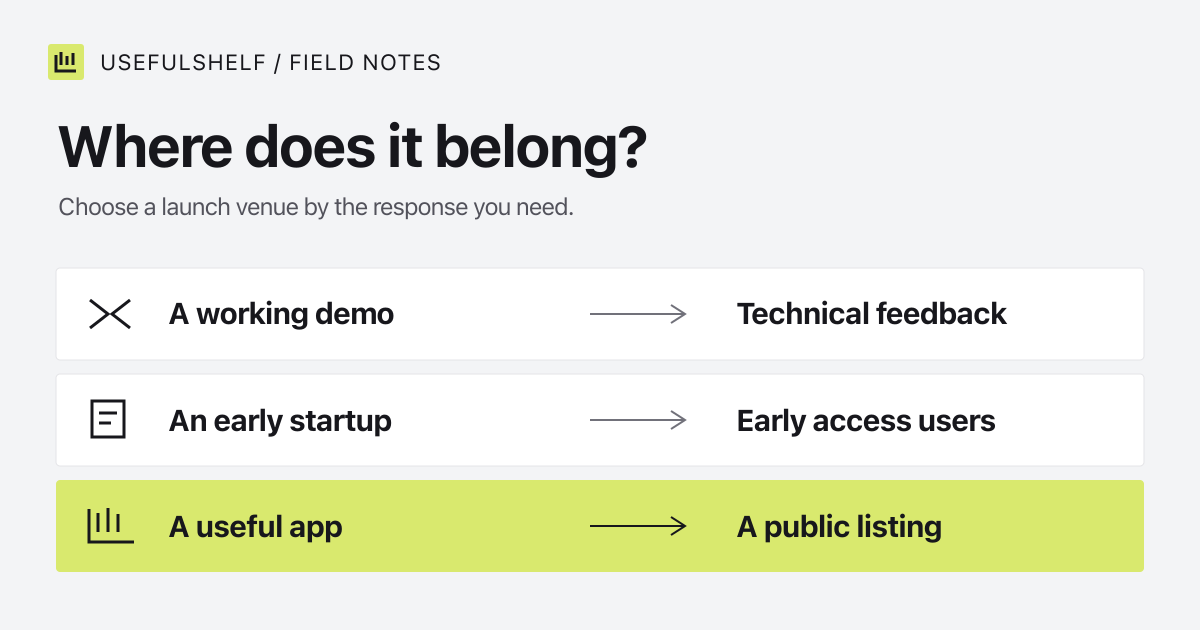
The useful question is not which launch site has the longest list of features. It is what you need from the people who see your product. Technical feedback, early access signups, and a public product listing are different outcomes.
This guide compares three Product Hunt alternatives by that decision. It does not rank them by traffic or backlink value. UsefulShelf is our own directory, so its inclusion is a disclosure, not an independent endorsement.
Choose the launch outcome first
| Your situation | Consider | Check first |
|---|---|---|
| A working product for a technical audience | Show HN | Can visitors try something substantial and discuss how it works? |
| A new technology startup seeking early users | BetaList | Does your site meet its stage, domain, and submission requirements? |
| A useful app needing a public directory page | UsefulShelf | Can it pass review and meet the chosen plan’s publishing requirements? |
Show HN: bring something people can try
Show HN is part of Hacker News. Its official guidelines ask for something you made that visitors can use. Landing pages, signup pages, newsletters, and fundraisers are not suitable Show HN submissions. The guidelines also ask makers to be present for the discussion and not solicit upvotes.
That makes it a reasonable option to investigate for a developer tool, a working prototype, or another product with a technical audience. A waitlist with a polished headline is a different kind of launch.
Before posting, write a short explanation of the problem, the interesting implementation choice, and one limitation. Test the demo from a logged-out browser. A reader should be able to understand what you built without watching a long promotional video.
BetaList: check stage and eligibility before preparing assets
BetaList’s criteria focus on upcoming or recently launched technology startups. It asks for a distinct product website and a way for visitors to get access or sign up. Its submission terms require your own domain and explain that submitting does not guarantee acceptance.
The same terms distinguish paid priority review from acceptance. Check current submission options directly before setting a budget or promising your team a launch date.
For an early SaaS product, the preparation question is simple: what happens when an interested visitor signs up? Explain whether they receive access immediately, join a waitlist, or need an invitation. Keep that expectation consistent between the submission and your website.
UsefulShelf: a reviewed page for your app
UsefulShelf publishes reviewed app pages with a description, category, structured data, and a direct website link. Public listings appear in the directory and sitemap. This gives readers and search tools a source about the product; it does not guarantee traffic, indexing, or an AI recommendation.
- Free nofollow: approval is required; no badge or payment is needed.
- Free dofollow: approval and a verified visible UsefulShelf badge are required.
- Paid dofollow: $9 once, with approval and confirmed payment; no badge is required.
See current listing options for availability, and the discovery guide for what a published listing page contains. Paid placement does not bypass review. Choose a plan based on the listing you want, not an assumed ranking improvement.
When Product Hunt itself still fits
You do not need to reject Product Hunt to use another channel. Its launch guide describes a community built around discovering and discussing products. If that audience overlaps with your users, a prepared launch can be a sensible experiment.
For a specialist invoicing tool, a small community of accountants might give more useful feedback than a broad launch audience. For a tool aimed at makers, a maker-focused venue may fit better. That is an audience hypothesis to test, not a claim about any platform’s conversion rate.
Reuse the assets, rewrite the introduction
Keep a folder with one screenshot, a short demo, your logo, pricing details, and the product URL. Then write the introduction for each venue. Technical readers may care about architecture and limitations; potential customers may need a clear description of the task.
A good submission explains who should try the product, what they can do now, and what is unfinished. Avoid copying a sales paragraph into every community. Respect each site’s promotion and participation rules.
Compare launches by what happens afterward
Use distinct tracking links where permitted. Record visits, signups, the first completed task, and the questions you receive. Revisit those users after the announcement day. A spike in views with no completed tasks tells you something different from a smaller group that returns.
Choose one launch experiment you can support properly, then use what you learn to prepare the next. The startup marketing plan shows how to fit that into a month of product and marketing work.
Platform rules checked September 28, 2026. This comparison uses published submission guidance; it does not claim firsthand traffic results from these platforms.