UsefulShelf
Idea validation
How to Find Micro SaaS Ideas People Might Pay For
Three specific problems to investigate, the questions to ask, and a small test for each. A research method, not a list of supposedly profitable ideas.
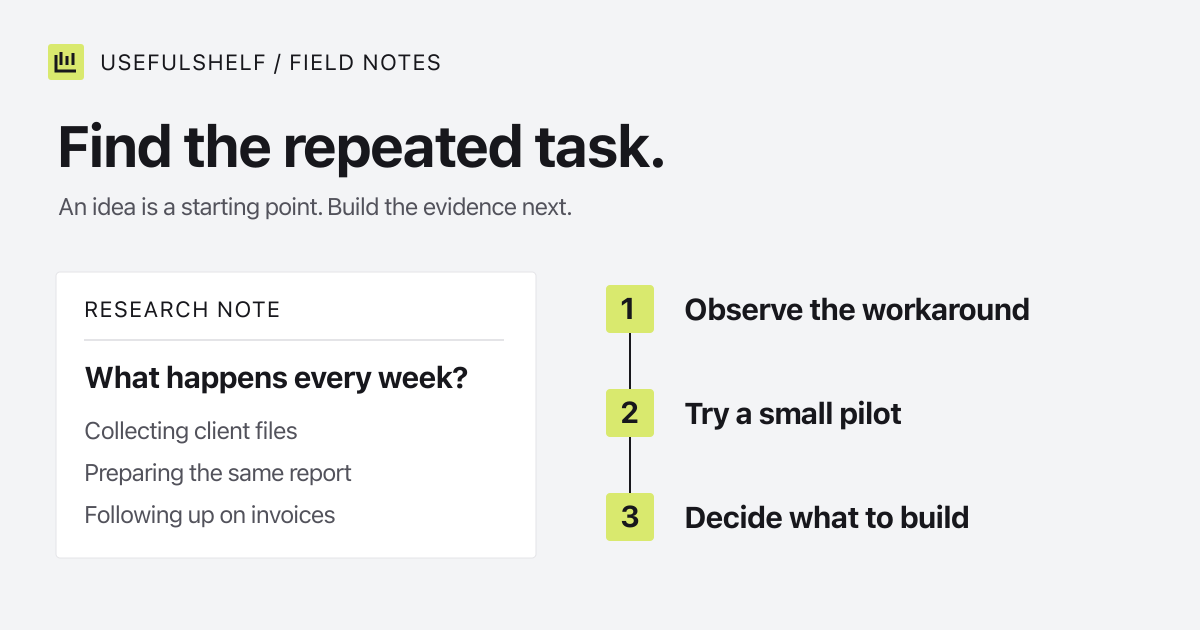
A list of micro SaaS ideas can be entertaining and still leave you with no one to sell to. “An AI tool for agencies” names a technology and an audience. It does not tell you what happened in someone’s working day that would make them look for a new product.
Start with a repeated task, an existing workaround, and a person you can reach. The three ideas below are research briefs. None has been validated here, and none is labelled profitable.
Find the workaround before designing the software
Look at the parts of a job that move between a spreadsheet, an inbox, and another tool. Ask someone to walk you through the last time they did the task. Request a redacted example if that helps, and avoid collecting client data you do not need.
Record four things: what triggered the task, the steps they took, where it became difficult, and what they did to finish. A story about last Tuesday is more useful than a prediction about whether they would use your future app.
Paul Graham’s essay Do Things That Don’t Scale makes the case for hands-on early work with users. For idea research, the practical lesson is to get close enough to the task that you can help with it manually before automating it.
Idea 1: collect project assets from clients
Who to speak to: a small design or web agency that waits for logos, photographs, copy, or approvals before starting a project.
What to investigate: how the agency knows what is missing, who follows up, and how it identifies the latest version. Do files arrive late because the request was unclear, because the client is busy, or because approval involves several people? A file-upload form will not solve all three.
The smallest pilot: create a project-specific request list and manually maintain its status for one willing team. Use tools the agency already permits. Agree on what would count as a useful result before starting.
Reason to stop: every project requires a bespoke process, the client will not use another destination, or an existing folder and checklist already solve the problem well enough.
Idea 2: prepare a recurring client report
Who to speak to: a consultant who regularly assembles the same client report from several sources.
What to investigate: separate copying information from interpreting it. Which fields are predictable? Which sections require judgment? Find out who checks the final report and how often the source format changes.
The smallest pilot: work with an approved, non-sensitive sample and produce the repeated portion of one report. Keep the consultant’s review step. Compare the work involved with the existing method; do not promise a time saving before measuring it.
Reason to stop: source access is unreliable, the report changes substantially each time, or setup costs more effort than the repeated task.
Idea 3: follow up on overdue invoices
Who to speak to: a freelancer who manages several recurring clients and sends follow-ups manually.
What to investigate: ask how they decide when to send a reminder and when not to. Some late invoices are administrative mistakes; others involve disputes or a deliberately flexible relationship. Automatic sending may be the wrong default.
The smallest pilot: a review queue showing the invoice, recipient, and proposed reminder. Let the freelancer approve each message. Test the decision process with sample data before involving a real client.
Reason to stop: their invoicing software already covers the task, there is no recurring need, or the unresolved problem is payment approval rather than remembering to follow up.
Use a decision note, not a made-up opportunity score
After a conversation, write a short note you could show a collaborator:
Task: What happens, and how often?
Evidence: What did the person actually show or describe?
Current solution: What works already?
Open question: What could invalidate this idea?
Next test: What will you do together, and when?
Keep observations separate from your interpretation. “They maintain two spreadsheets” is an observation. “They would pay to replace them” is a hypothesis until they make a concrete decision.
There is no universal interview count that proves an idea. Look for repeated evidence, then ask for a meaningful next step: a scheduled pilot, access to a safe sample, or a purchase you can actually fulfill. A positive reaction alone is a weak basis for months of development.
Research alternatives before writing the feature list
Search for the task in the words your prospective customer used. Review product documentation, pricing, and the way existing tools explain their audience. The absence of a feature on a homepage does not prove a gap; check the documentation or ask the vendor.
A useful distinction may be a narrower audience, a simpler setup, or compatibility with a specific workflow. It needs to matter to the buyer. “Has AI” does not explain why someone would leave a working tool.
What to build after the first useful pilot
Automate the repeated step you understand, and keep the review points where judgment matters. Decide how you will recognize success during the next real use. For the invoice idea, that might mean an approved reminder sent to the intended recipient, not merely a signup.
Once the task works, prepare an explanation around it. The SaaS marketing guide takes that next step: turn a specific problem into a demonstration, choose a channel, and learn from the people who try it.